How Does the Hourglass Symbol Indicate Expiration Date Meaning?
The hourglass symbol, historically denoting the passage of time, now serves an essential role in various modern applications. Originating in the Middle Ages as a time-measuring device for sailors, it evolved into a metaphor for the finite nature of time.
Today, it is widely recognized in contexts like food packaging, medication, and software licenses to indicate expiration dates. This universal symbol bridges language barriers and guarantees consumer safety by conveying time sensitivity.
Its integration in digital and practical domains underscores its relevance in managing temporal aspects effectively. Learn more about this symbol's significance across different sectors.

Key Takeaways
- The hourglass symbol indicates the remaining time before a product or software license expires.
- It is a universally recognized icon for signaling time sensitivity and expiration dates.
- In food and medication packaging, it ensures consumer safety by highlighting expiration dates.
- It helps bridge language barriers by providing a clear visual cue for expiration.
- The symbol is pivotal in software license management, warning users of impending license termination.
Historical Significance
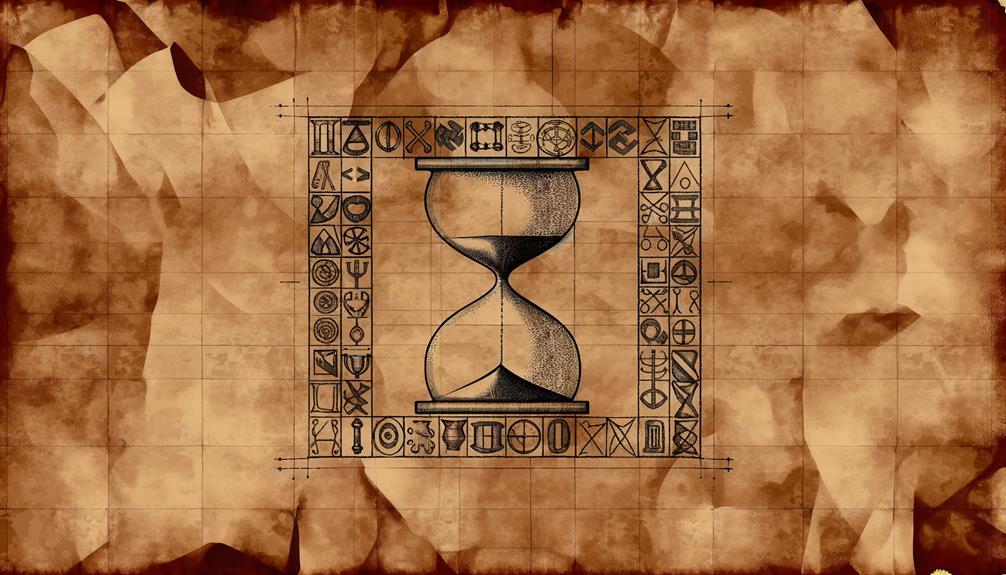
Historically, the hourglass has served as a powerful symbol of the passage of time, dating back to its origins in the Middle Ages. This simple yet profound instrument, consisting of two glass bulbs connected by a narrow neck, was first used by sailors to measure time at sea accurately.
The hourglass represented the relentless flow of time, as sand trickled steadily from one bulb to the other. As a practical tool, it found its way into various aspects of medieval life, including religious rituals and academic pursuits. Its symbolism grew over centuries, embodying the transient nature of existence and the inevitability of life's end.
Through this contextual evolution, the hourglass became an enduring metaphor for the finite nature of time.
Symbolism in Modern Times
In contemporary society, the hourglass symbol has evolved to represent more than just the passage of time; it now holds significant cultural relevance and has been adapted for digital applications.
This transformation can be traced from its traditional use in indicating ephemeral moments to its modern representation as a digital icon for loading or waiting.
Digital Age Interpretation
As digital technology increasingly permeates everyday life, the hourglass symbol has evolved from a mere representation of time to a multifaceted icon signifying loading, waiting, and the inevitable passage of digital expiration. Initially, hourglasses in digital interfaces denoted buffering or processing delays, mirroring the patience required in pre-digital times.
Over time, the symbol's use extended to signify deadlines and timeouts in digital contexts, embodying the transient nature of data and online presence. Modern interpretations now encompass warning indicators for expiring subscriptions, software licenses, and temporary data.
This evolution underscores the hourglass's shift from a physical timepiece to a digital harbinger, reflecting our growing reliance on and interaction with technology.
Cultural Relevance Today
The hourglass symbol, once a mere emblem of the passage of time, has evolved into a powerful cultural icon reflecting society's nuanced relationship with temporality and technology.
In the digital age, it first became synonymous with waiting, appearing as an icon during computer processing delays. Today, it has developed further, symbolizing urgency and the finite nature of time in various contexts, such as environmental awareness and personal productivity.
This transformation highlights a shift from passive recognition of time to active engagement with its limits. The hourglass now serves as a reminder of life's impermanence, urging individuals and societies to act with intention and purpose, bridging ancient wisdom with contemporary relevance.
Food Packaging Indicators
Food packaging indicators, such as the hourglass symbol, play a pivotal role in informing consumers about the expiration dates and overall freshness of products. Initially, expiration dates were simply printed, but the increasing need for clear communication led to the adoption of visual symbols.
The hourglass icon emerged as a universally recognized indicator of time sensitivity, effectively bridging language barriers. These symbols, often accompanied by 'best by' or 'use by' dates, guarantee consumers can make informed decisions about product safety and quality.
Advanced packaging technologies now integrate color-changing labels and smart tags, providing real-time freshness updates. These innovations underscore the critical importance of reliable expiration indicators in maintaining consumer trust and securing food safety.
Medication Expiry Warnings
Medication expiry warnings are essential for ensuring patient safety and treatment efficacy. Consuming expired medications can lead to reduced effectiveness or harmful side effects. These expiration indicators, often represented by the hourglass symbol, are strategically placed on packaging to provide clear and accessible information.
Understanding and adhering to these warnings is vital for maintaining the integrity of pharmaceutical care.
Importance of Expiry Dates
Often overlooked yet significantly crucial, expiration dates on medications serve as essential indicators of a drug's efficacy and safety over time. As medications age, their chemical composition can change, potentially leading to diminished effectiveness or even harmful side effects. Healthcare professionals emphasize the importance of strict adherence to these dates to avoid these risks. Research shows that expired medications can become less potent or, in some instances, toxic.
| Aspect | Impact |
|---|---|
| Efficacy | Diminished over time |
| Safety | Potential harmful effects |
| Stability | Chemical alterations |
| Regulatory Compliance | Ensures patient well-being |
| Storage Conditions | Impact on longevity |
Understanding these factors helps individuals use medications safely and effectively.
Identifying Expiration Indicators
Recognizing the various symbols and indicators on medication packaging is crucial for guaranteeing that the drugs are used within their effective and safe time frame. Common indicators include the hourglass symbol, which signifies that the medication's expiration date is approaching.
Additionally, 'EXP' followed by a date denotes the last month and year the drug is considered effective. Visual checks for changes in color, texture, or odor can also indicate degradation.
Chronologically, manufacturers first label the drug with a production date, followed by an expiration date, and may include storage recommendations. Understanding these indicators guarantees that users do not consume expired medications, thereby maintaining the efficacy and safety of their treatments.
Software License Validity
The hourglass symbol often signifies the expiration date of a software license, indicating that the validity period is nearing its end and renewal or extension may be necessary. Historically, software licenses have defined usage terms, often coupled with a time-bound agreement.
As software evolves, license management has become essential, requiring timely renewals to maintain functionality and compliance. Users are typically alerted via the hourglass symbol, prompting proactive measures. Overlooking this symbol can lead to operational disruptions, access loss, or non-compliance penalties.
Recognizing and responding to this visual cue ensures software continuity. In modern software ecosystems, license validity is a crucial aspect, underscoring the need for regular monitoring and timely action to mitigate risks associated with expired licenses.
Cosmetics Shelf Life
Understanding the shelf life of cosmetics is essential for ensuring both product efficacy and consumer safety. Cosmetics typically display a Period After Opening (PAO) symbol, often resembling an open jar with a number indicating months of safe use post-opening. This aligns with regulatory guidelines aimed at minimizing microbial contamination and ingredient degradation.
Initially, unopened products have a longer shelf life, often two to three years depending on formulation and storage conditions. Once opened, exposure to air, light, and bacteria expedites deterioration. Preservatives and packaging innovations have extended usability, yet adherence to expiration dates remains critical.
Regular monitoring of texture, color, and scent changes can also signal product expiration, thereby maintaining skin health and preventing adverse reactions.
Digital Content Expiration
While the concept of expiration is traditionally associated with perishable goods, digital content also faces obsolescence due to rapid technological advancements and shifting user preferences. Digital media, from software to streaming services, often become outdated, necessitating updates or replacements. This phenomenon can be traced through several phases:
| Phase | Description | Impact |
|---|---|---|
| Initial Launch | Introduction of new digital content | High user engagement |
| Peak Usage | Wide adoption and regular use | Maximum relevance |
| Decline | Decrease in usage as alternatives emerge | Reduced engagement |
| Obsolescence | Content becomes outdated | Minimal to no use |
| Discontinuation | Official end of content availability | Complete phase-out |
This lifecycle underscores the importance of continual innovation and adaptation to maintain digital content relevance.
Consumer Awareness
In an era where digital content rapidly evolves, fostering consumer awareness about expiration dates and content lifecycle stages is essential for maintaining engagement and satisfaction. Thorough research indicates that clear communication of these elements is vital for building trust and loyalty.
Consumers increasingly rely on accurate information to make informed decisions. Contextual analysis of user behavior shows a preference for transparency and easy access to expiration details.
Key strategies for enhancing consumer awareness include:
- Clear labeling: Use universally recognized symbols like the hourglass.
- Timely notifications: Provide reminders as expiration dates approach.
- Educational content: Offer guides on understanding expiration symbols.
- Accessible information: Make sure details are easy to find and read.
- Feedback mechanisms: Allow consumers to ask questions and provide input.
Time Management Implications

The integration of clear expiration date symbols like the hourglass not only enhances consumer awareness but also directly impacts time management strategies for both users and content providers.
For users, the hourglass symbol serves as a visual cue to prioritize usage, minimizing waste and optimizing resource allocation.
Content providers, on the other hand, can leverage these symbols to synchronize inventory restocks, manage promotional timelines, and forecast demand patterns more accurately.
As the symbol becomes more ubiquitous, it fosters a disciplined approach to both consumption and distribution.
Over time, this can lead to streamlined operations, reduced costs, and improved customer satisfaction.
Essentially, the hourglass symbol acts as a catalyst for more efficient time management across the supply chain.
Conclusion
The hourglass symbol, a timeless sentinel of passing moments, now transcends its historical roots to serve as a universal indicator of expiration across various domains.
From food packaging and medication to software licenses and cosmetics, it underscores the impermanence inherent in consumables and digital content.
As consumers navigate this emblematic landscape, awareness of expiration dates becomes paramount, ensuring safety and efficacy.
Therefore, the hourglass, an ancient harbinger of time's march, remains ever relevant in modern times.







Can you be more specific about the content of your article? After reading it, I still have some doubts. Hope you can help me.
The landscape of text-to-video AI has undergone a seismic shift in the past year,
moving from grainy, abstract motion experiments to coherent, high-fidelity
narrative sequences. While early models like Meta’s Make-A-Video and Google’s Imagen Video
laid the groundwork by proving the concept, they were plagued by artifacts, temporal inconsistency, as
well as a limited understanding of physics. The most demonstrable advance currently available, however, is embodied in Pika 2.0, a platform which includes leapfrogged its predecessors by
solving the critical problem of “prompt adherence” and introducing granular,
user-controlled scene composition. This advance isn’t merely incremental; it represents a paradigm shift from generating “videos from text” to “directing videos from text.”
Review my blog; cool questions to ask chatgpt (https://poweraitools.net)
I don’t think the title of your article matches the content lol. Just kidding, mainly because I had some doubts after reading the article.